Yearn developer Schlag gives feedback on basic onchain integration of Uniswap V4 and their universal router
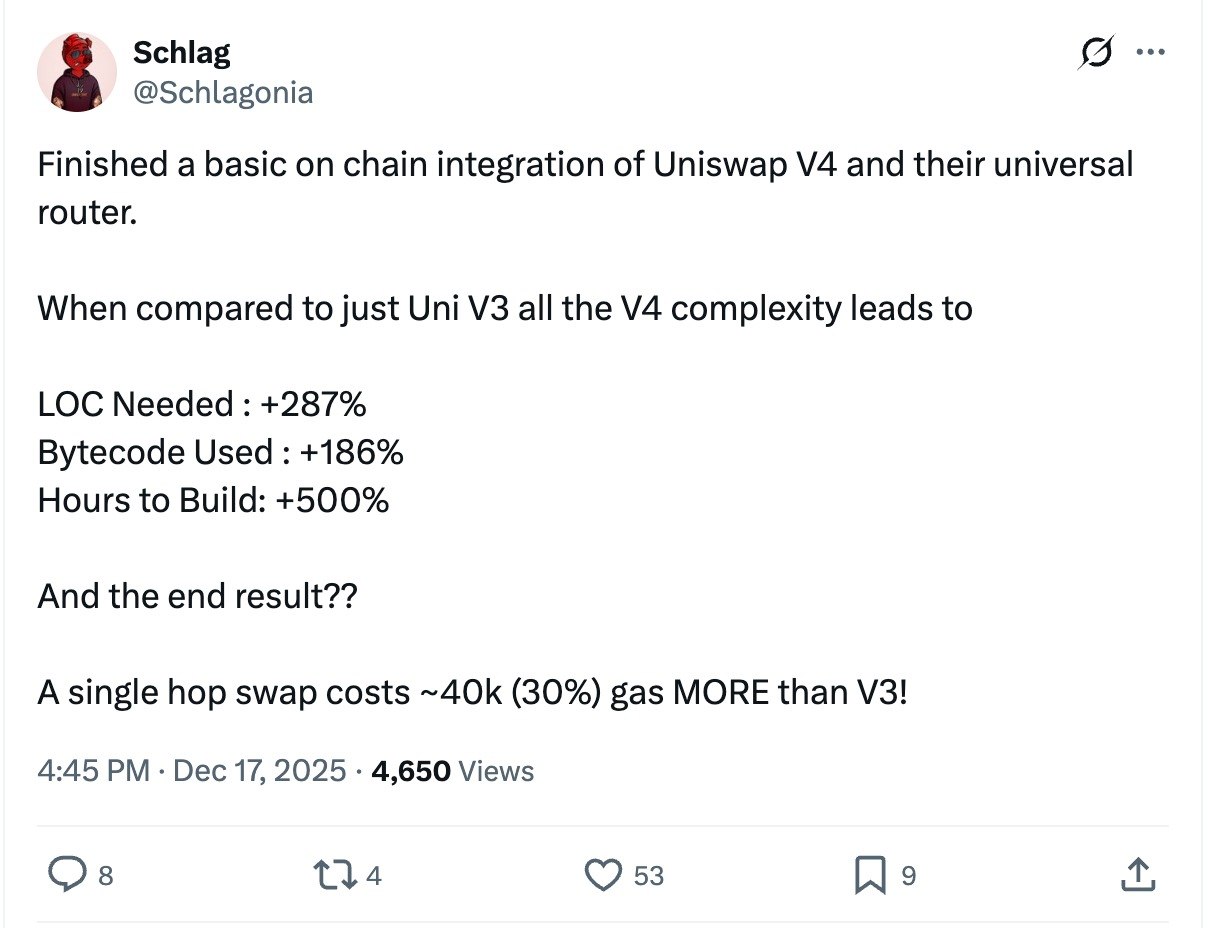
𝕏/@Schlagonia •
Revision history
12 recorded changes
Want your article here?
Promote with Leviathan News12 recorded changes
Want your article here?
Promote with Leviathan NewsYearn developer Schlag (known as @Schlagonia) published onchain feedback after attempting a basic integration of Uniswap v4 using the current Universal Router and periphery contracts, highlighting rough edges and missing pieces from a protocol integrator’s perspective. His comments focus on how straightforward it is today for external protocols like Yearn to build simple, production-ready workflows on top of v4’s new architecture (singleton PoolManager, hooks, native ETH support, flash accounting), using the router/unified entry point that Uniswap is promoting for v2/v3/v4. According to Uniswap’s own documentation, the Universal Router is intended as a single command-based router that aggregates swaps and liquidity actions across Uniswap v2, v3 and v4, handling ETH wrapping, Permit2 approvals, multi-hop swaps and basic v3/v4 position manager interactions in one transaction. However, recent audits of the v4 periphery and Universal Router by OpenZeppelin point out concrete limitations that directly affect integrators, including the inability to modify certain native-token liquidity positions via the router, restrictions around migrating wrapped native assets from v3 to native positions in v4, and the router’s receive function not accepting native tokens from the v4 PoolManager, which constrains mixed-protocol trades that route through native ETH. Schlag’s onchain tests and feedback sit in this context: they are early, practical validation of how these architectural and security choices impact real DeFi integrations, and they help both Uniswap and downstream protocols identify where tooling, interfaces, or router behavior may need to be refined before v4 is widely adopted.
AI-generated background, compiled from web sources — not editorial content.

leviathan.news ·
𝕏/@yearnfi ·
𝕏/@banteg ·

𝕏/@yAuditDAO ·

𝕏/@NourHaridy ·

𝕏/@BirchHill_io ·
leviathan.news ·
𝕏/@yearnfi ·
𝕏/@banteg ·
𝕏/@yAuditDAO ·
𝕏/@NourHaridy ·
𝕏/@BirchHill_io ·
🚀 Love DeFi? Ready to dive in and start earning $SQUID while making an impact?