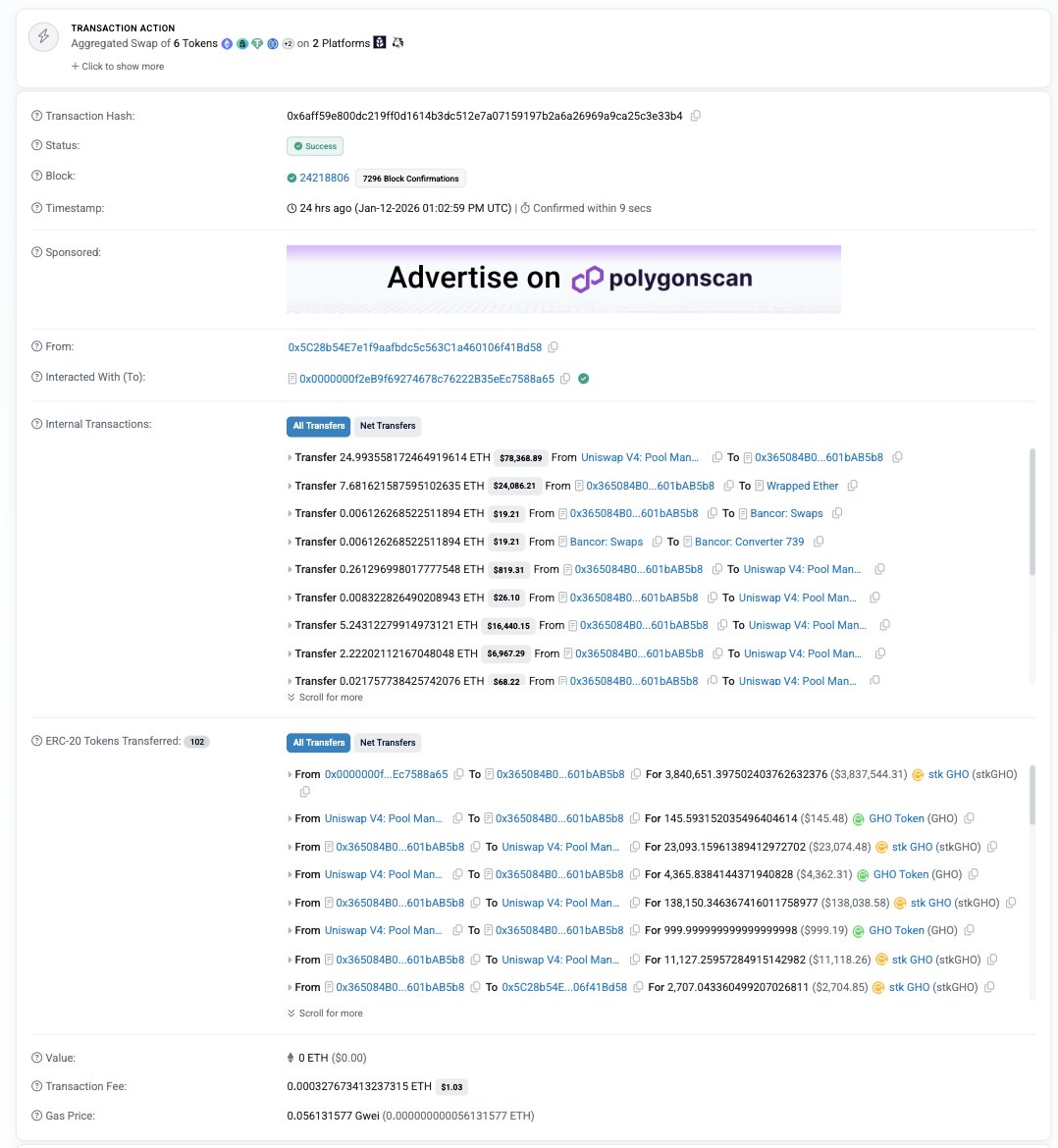
On-chain data and security alerts show that DeFi protocol YO / Yield suffered an internal vault loss of about $3.7 million after an automated strategy executed a disastrously mispriced stablecoin swap from stkGHO to USDC. The vault’s harvesting/rotation logic swapped roughly 3.84 million stkGHO (GHO) for only about 112,000 USDC, implying extreme slippage and crystallizing a large loss relative to the intended value of the position. Blockchain security firm PeckShield first flagged the incident, describing it as a “major financial hit” linked to a vault operation, while subsequent reporting and project statements framed it as an operational error rather than an external exploit.
According to post-incident explanations, the error arose in a vault harvesting system meant for claiming relatively small rewards, which instead traded the vault’s full stkGHO balance at a very unfavorable price because slippage protections and guardrails were insufficient for a transaction of that size. Analysts have linked the root cause to a common design risk in yield vaults and yield farming protocols that automate capital rotation without robust per-trade slippage and size checks, especially when interacting with thinner liquidity in certain stablecoin pairs. YO has said that no external user deposits were lost and that the loss was borne at the vault/protocol level, with additional safeguards and slippage protection now implemented to prevent similar incidents. The episode underscores ongoing operational and smart-contract risk in DeFi yield strategies, even when dealing with ostensibly low-volatility assets like stablecoins such as Aave’s GHO/stkGHO and Circle’s USDC.
"entities":["YO Protocol","Yield","PeckShield","PeckShieldAlert","stkGHO","GHO","Aave","Aave GHO","USDC","Circle","YO vault / Yield vault","DeFi yield vaults","Hacken","Yehor Rudytsia"]}`
✨ AI-generated background, compiled from web sources — not editorial content.