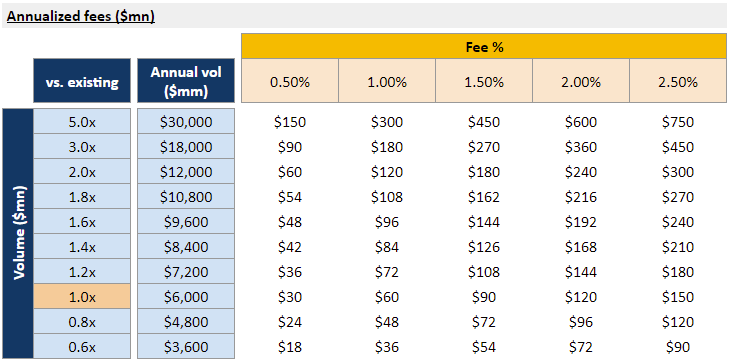
0xRamen breaks down how Blur's $6 billion annual volume would potentially generate $150m in fees
𝕏/@0xramenumai •
Revision history
3 recorded changes
Want your article here?
Promote with Leviathan News3 recorded changes
Want your article here?
Promote with Leviathan NewsOn-chain analyst 0xRamen published a fee-revenue breakdown for NFT marketplace Blur, arguing that if Blur sustains around $6 billion in annual trading volume, it could theoretically generate roughly $150 million in annual fees under a more traditional marketplace-fee model. Blur currently operates with 0% marketplace fees and relies primarily on creator royalties and token incentives, so the thread explores a “what if Blur charged fees like a normal exchange/marketplace?” framing rather than describing Blur’s actual current revenue. Blur, launched in 2022 and designed for professional NFT traders, grew rapidly by offering zero-fee trading, advanced trading tools, and token incentives, at one point handling more than three-quarters of global NFT trading volume. According to analytics platforms such as Token Terminal, Blur’s contracts facilitate large volumes of NFT bids and trades, and 0xRamen’s analysis extrapolates from this observed volume to estimate what Blur could earn if it imposed a modest percentage fee similar to centralized exchanges or other NFT marketplaces. The implied ~$150 million figure corresponds to a blended fee rate of around 2.5% on $6 billion of annual volume, which is in line with fee structures historically used by NFT platforms like OpenSea, and is mainly used as a way to contextualize the potential economic value of Blur’s order flow rather than to describe realized income. This kind of modeling matters for several reasons: it highlights the trade-off between growth via zero-fee, incentive-heavy strategies and sustainable, fee-based business models; it gives a back-of-the-envelope valuation anchor for Blur’s ecosystem by mapping raw trading volume into hypothetical revenue; and it feeds into ongoing debates about how NFT marketplaces should split economics between platforms, traders, and creators via royalties. For token holders and market participants, such breakdowns are used to think about long-term platform sustainability and what Blur’s economics might look like if incentives taper and fees or other revenue mechanisms are introduced or expanded.
AI-generated background, compiled from web sources — not editorial content.
Loading related coverage…
Loading comments…
🚀 Love DeFi? Ready to dive in and start earning $SQUID while making an impact?
Restoring your session before loading comments…
Related coverage is temporarily unavailable.