Singapore declares Polymarket illegal gambling, blocks access amid global crackdown.
DL News •
Revision history
4 recorded changes
Want your article here?
Promote with Leviathan News4 recorded changes
Want your article here?
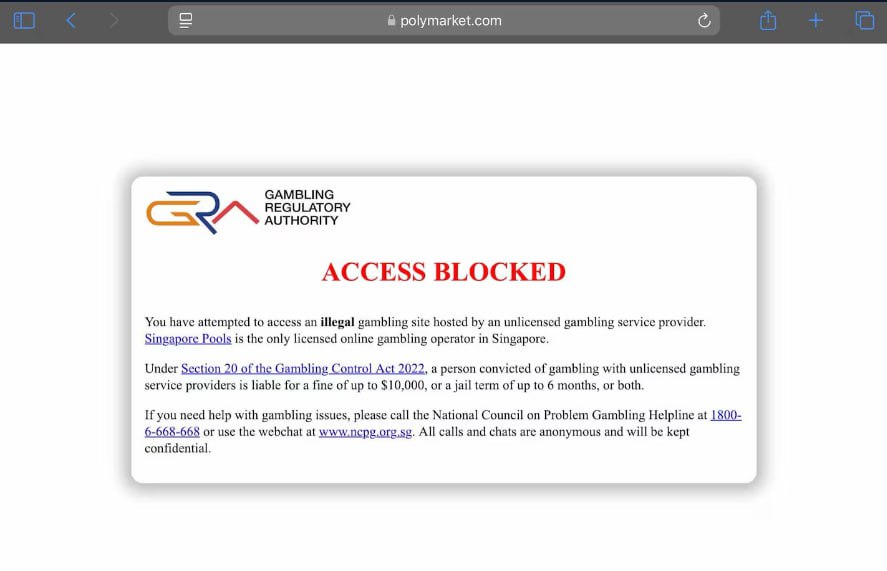
Promote with Leviathan NewsSingapore’s Gambling Regulatory Authority (GRA) has formally classified blockchain-based prediction market Polymarket as an illegal online gambling service and ordered internet providers to block access for users in the country. The move is part of Singapore’s broader crackdown on unlicensed remote gambling, under which more than 3,800 gambling websites have been blocked this year and only state-owned Singapore Pools is permitted to offer legal online betting. Users in Singapore who attempt to access or use Polymarket despite the ban risk penalties of up to S$10,000 in fines, up to six months’ imprisonment, or both under the Gambling Control Act. Regulators concluded that Polymarket’s core activity—allowing users to stake money via cryptocurrency on the outcomes of real-world events and receive payouts depending on how events resolve—constitutes gambling rather than information forecasting, regardless of its decentralized, blockchain-based structure. The ban aligns Singapore with other jurisdictions including the United States, France, Taiwan and Romania, which have also restricted or blacklisted Polymarket as an unlicensed gambling or derivatives platform. Authorities have highlighted concerns about the platform’s use of crypto, user pseudonymity and ease of cross-border access, noting that some Singapore-related markets on Polymarket have attracted significant activity even after the block, and warning that attempts to circumvent geoblocks (for example via VPNs) may themselves be prosecutable offences. The case has become a reference point in the global regulatory debate over crypto prediction markets, underscoring that regulators are increasingly treating such venues as gambling or financial betting products subject to licensing, consumer protection and anti–money laundering rules. Commentary around the decision argues that Singapore’s enforcement illustrates a broader pattern: decentralization and on-chain settlement do not exempt platforms from local gambling and financial regulations, and prediction markets may need to either obtain licenses or redesign their models if they want compliant access to major markets.
AI-generated background, compiled from web sources — not editorial content.

𝕏/@OpenWorldsAI ·

The Block ·

The Block ·

𝕏/@sharexyz ·

𝕏/@TheBlockCo ·

Shayne Coplan ·
𝕏/@OpenWorldsAI ·
The Block ·
The Block ·
𝕏/@sharexyz ·
𝕏/@TheBlockCo ·
Shayne Coplan ·
🚀 Love DeFi? Ready to dive in and start earning $SQUID while making an impact?