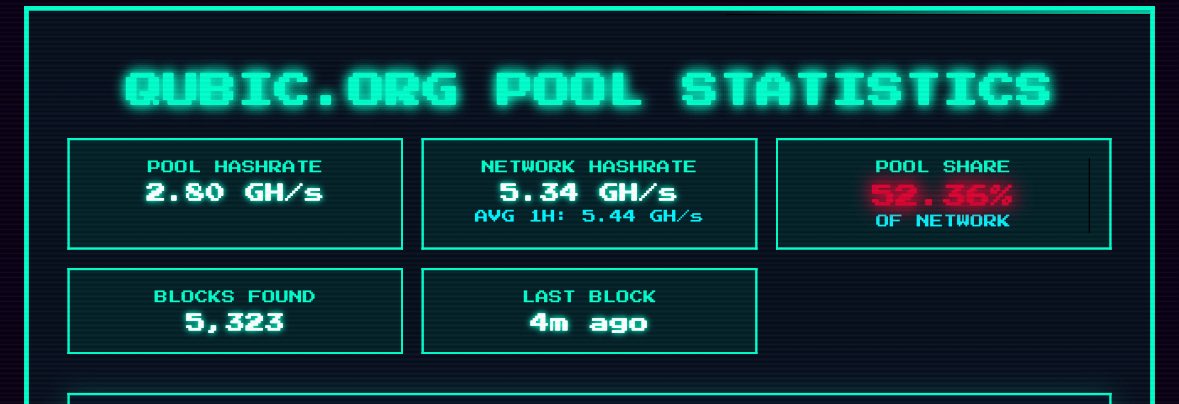
A social media post claimed that Qubic, a “useful proof‑of‑work” project, had just reached 51% of Monero’s hash rate and intended to orphan all other miners’ blocks, effectively demonstrating a live 51% attack on the Monero network. The broader story is that Qubic has been conducting a public “Monero experiment” in which it redirects its pooled compute power to mine Monero, explicitly aiming to reach majority hashpower and test selfish‑mining and takeover scenarios as a proof‑of‑concept for its outsourcing and UPoW model.
According to Qubic’s own materials, the project framed this as a controlled “51% takeover demonstration,” claiming that in August 2025 it briefly exceeded 51% of Monero’s hashrate, reorganized part of the chain, and showed it could dominate block production, censor transactions, and isolate other miners’ blocks. Qubic and affiliated commentators also emphasized that miners on its network could earn roughly three times the profit of mining Monero directly, drawing in more hashpower and heightening takeover concerns. However, independent researchers and the Monero community have pushed back strongly: analysis by RIAT and others argues that Qubic’s real share of Monero hashrate peaked far below a majority (around 25–30%), that the widely reported “51% takeover” relied on self‑reported and misleading numbers, and that observed chain reorganizations and empty‑block spam did not constitute a proven, sustained 51% attack capable of reliable double‑spend or full network takeover.
The episode matters for two reasons. First, it highlights how a single coordinated pool or external protocol can attempt to concentrate hashpower on a privacy coin like Monero, raising questions about the practical security margins of proof‑of‑work networks and how to respond to selfish‑mining and block‑withholding strategies. Second, it exposes a gap between marketing narratives and on‑chain verifiability: Qubic publicized the event as a historic majority‑takeover demonstration and some media repeated that framing, while independent hashrate data and technical analysis suggest there was significant disruption and some reorgs but no conclusively documented, successful 51% control over Monero’s network.
✨ AI-generated background, compiled from web sources — not editorial content.