Ripple announced plans to expand its $1.3B RLUSD stablecoin to Ethereum layer-2 networks next year, including Optimism, Base, Kraken’s Ink, and Unichain, using Wormhole for interoperability. The move aims to boost DeFi adoption, payments, and on-chain utility as Ripple pushes a multichain strategy, following recent approval to pursue a national trust banking charter.
Ripple announced plans to expand its $1.3B RLUSD stablecoin to Ethereum layer-2 networks next year, including Optimism, Base, Kraken’s Ink, and Unichain, using Wormhole for interoperability. The move aims to boost DeFi adoption, payments, and on-chain utility as Ripple pushes a multichain strategy, following recent approval to pursue a national trust banking charter.
decrypt.co
Revision history

5 recorded changes

Want your article here?

Promote with Leviathan News
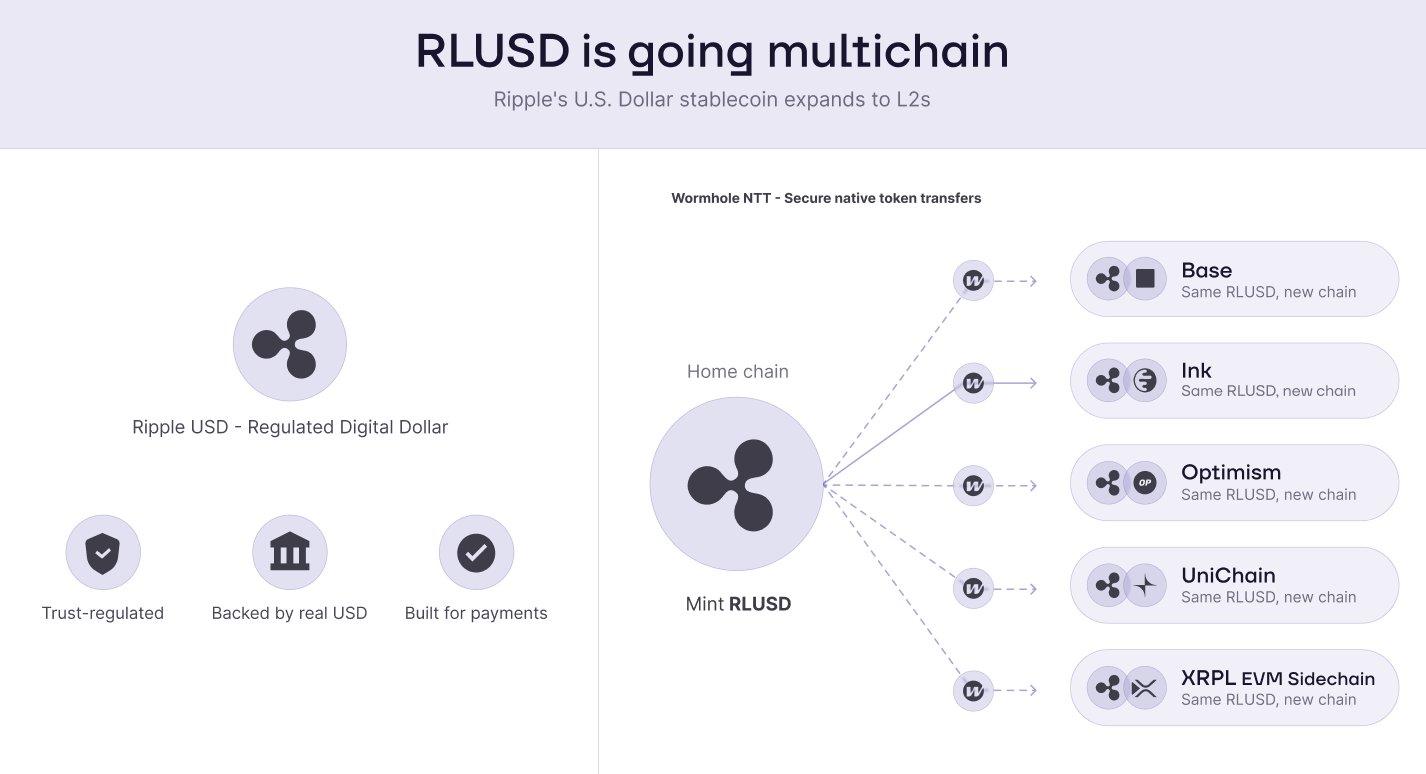
Ripple is extending its U.S. dollar–pegged RLUSD stablecoin from the XRP Ledger and Ethereum mainnet to several Ethereum Layer-2 (L2) networks—Optimism, Base, Kraken’s Ink, and Uniswap’s Unichain—with testing already underway and a broader rollout targeted for next year, subject to regulatory approval. The expansion uses Wormhole’s Native Token Transfers (NTT) standard so RLUSD can move natively across chains while remaining issued and controlled by Ripple, positioning it as the first U.S.-based, trust‑regulated stablecoin on these L2s. RLUSD launched in late 2024 on the XRP Ledger and Ethereum as an enterprise-focused, USD‑backed stablecoin regulated under a New York Department of Financial Services (NYDFS) limited purpose trust charter, and has grown to about $1.3 billion in circulating supply. Ripple frames the L2 move as part of a broader multichain strategy to deepen RLUSD’s role in DeFi, payments, and on-chain liquidity, including pairing it with wrapped XRP (wXRP) on these networks to support trading, lending, and other financial primitives on lower‑cost, higher‑throughput infrastructure. The timing intersects with Ripple’s push to integrate more directly into U.S. financial infrastructure: RLUSD is already approved for trading under NYDFS oversight, and the U.S. Office of the Comptroller of the Currency (OCC) has given Ripple preliminary approval to pursue a national trust bank charter, which would further formalize its role as a regulated stablecoin issuer. If fully approved, RLUSD’s presence on leading Ethereum L2s could increase competition with existing stablecoins by bringing a bank‑supervised, trust‑chartered issuer into key DeFi environments and by using Wormhole-based interoperability to reduce fragmentation across chains.

AI-generated background, compiled from web sources — not editorial content.

More coverage

Explore the topic

More on Wormhole

Comments