Ethereum's upcoming Pectra upgrade to adjust validator stake range to ease operational burden and enhance reward opportunities for validators.

The Block •
Revision history
2 recorded changes
Want your article here?
Promote with Leviathan News2 recorded changes
Want your article here?
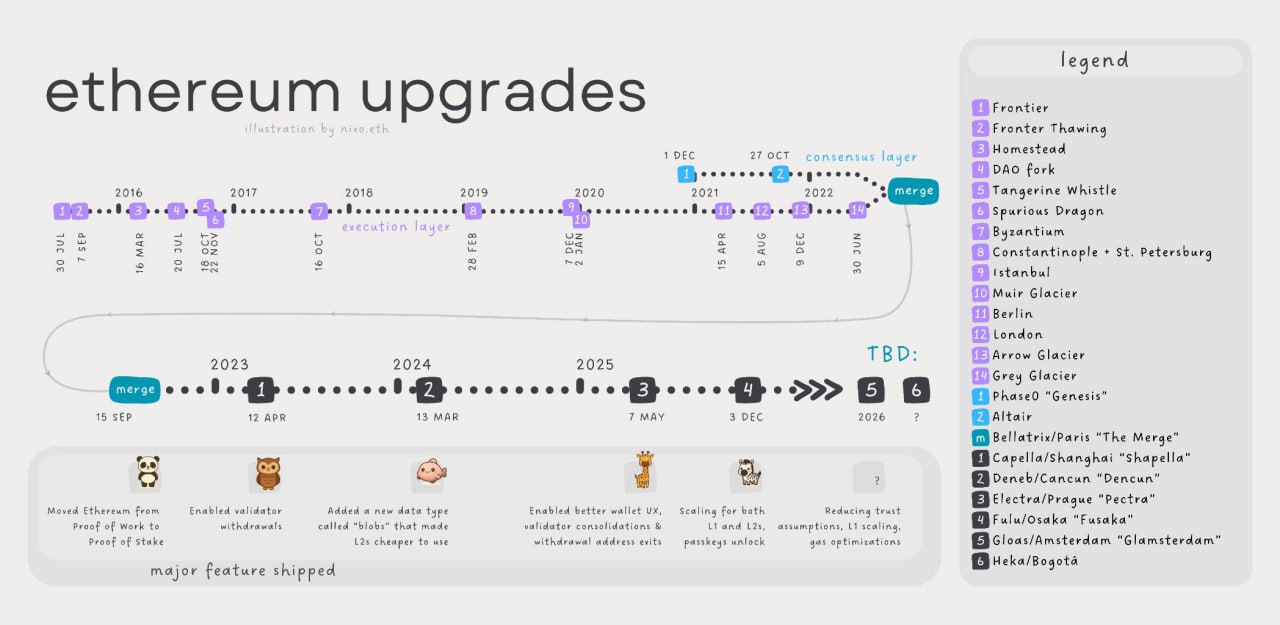
Promote with Leviathan NewsEthereum’s Pectra upgrade changes the validator staking rules by raising the maximum effective balance per validator from 32 ETH to 2,048 ETH, allowing a single validator to hold and earn rewards on any amount between 32 and 2,048 ETH. Previously, each validator could only effectively stake 32 ETH, forcing larger stakers to run many separate validator instances to deploy more capital. The change is implemented via EIP‑7251, part of Pectra, the combined Prague (execution layer) and Electra (consensus layer) hard fork. The minimum effective balance to become a validator remains 32 ETH, so the entry barrier for solo stakers is unchanged, but larger operators can now consolidate multiple 32 ETH validators into fewer, higher-balance validators. According to Ethereum’s roadmap documentation and institutional analyses, this consolidation is expected to ease the operational burden of running many validator nodes, reduce network overhead, and enable more efficient reward compounding because rewards above 32 ETH on a validator will now also earn staking yield up to the new 2,048 ETH cap. This adjustment matters for both small and large stakers. For solo validators, it allows balances slightly above 32 ETH (for example, 33 ETH) to fully participate in rewards, improving capital efficiency over time. For institutional and large staking providers, it simplifies infrastructure management by cutting the number of validator instances and associated keys, monitoring, and networking requirements, while also marginally reducing load on the consensus layer gossip network. More broadly, Pectra—described as Ethereum’s largest upgrade bundle to date with 11 EIPs—pairs these staking changes with other improvements such as account-abstraction-related features and increased blob throughput, aiming to improve scalability, UX, and validator economics without altering Ethereum’s overall proof‑of‑stake design.
AI-generated background, compiled from web sources — not editorial content.

𝕏/@renaissancing_ ·
Coindesk ·

Cryptonews ·

Cryptonews ·

youtu.be ·
ethereum.org ·
𝕏/@renaissancing_ ·
Coindesk ·
Cryptonews ·
Cryptonews ·
youtu.be ·
ethereum.org ·
🚀 Love DeFi? Ready to dive in and start earning $SQUID while making an impact?