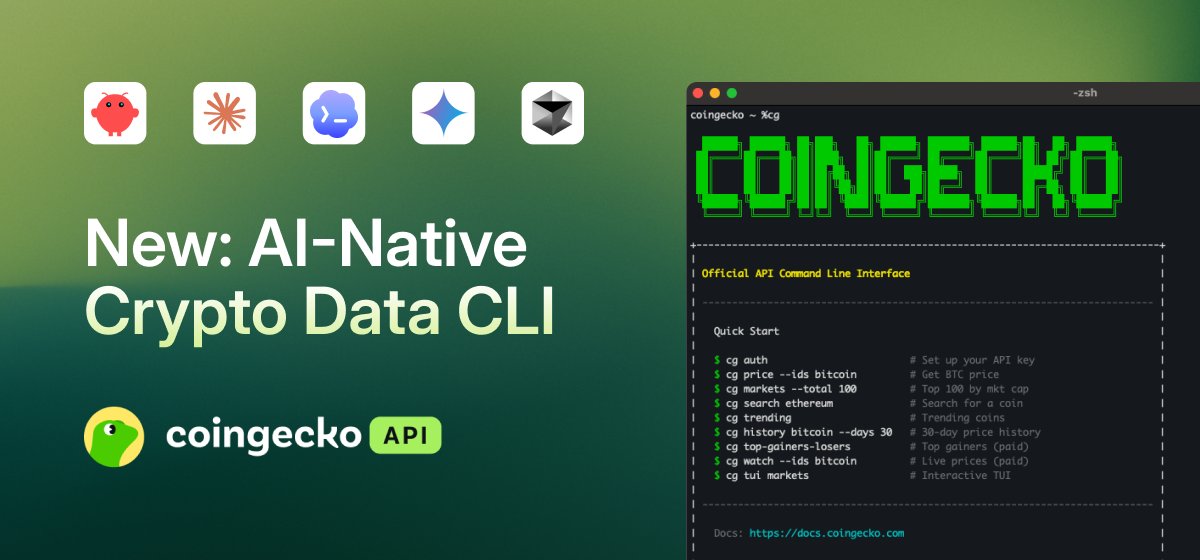
CoinGecko has launched the CoinGecko CLI, a free, open‑source command‑line interface that lets developers and AI agents access its real‑time and historical crypto market data directly from the local terminal, streamlining data-heavy and AI-driven crypto workflows. The tool is written in Go and is positioned as a high‑performance terminal interface that sits between raw API calls and local data workflows, providing both interactive dashboards and machine‑readable output for automation.
According to CoinGecko’s documentation, the CLI (invoked as cg) supports more than 10 years of historical data, 50+ fiat currencies, 500+ categories, and an interactive TUI (text user interface) with 7‑day price charts and CSV export, all powered by the CoinGecko API. The project is distributed as open source on GitHub and can be installed via Homebrew, an install script, or Go tooling, after which users authenticate with a CoinGecko API key (Demo or Pro) to start querying prices, market data, and categories from the terminal. CoinGecko frames the CLI as part of a broader “AI Agent Hub,” alongside MCP servers and agent skills, to make it easier for crypto‑focused AI agents and automation frameworks (such as OpenClaw) to pull bulk data, run analyses, and export results in a more token‑efficient and infrastructure‑light way.
This launch matters because it lowers friction for building and operating crypto‑aware AI agents and data pipelines: instead of writing custom API integrations for every workflow, developers can shell out to a stable CLI tool that returns structured data suitable for scripting, backtesting, and monitoring. For AI agents in particular, a local CLI with machine‑readable output can reduce token usage and latency versus repeatedly calling remote tools, while still leveraging CoinGecko’s breadth of coverage across tens of thousands of assets, hundreds of exchanges, and multiple networks through its existing API infrastructure.
✨ AI-generated background, compiled from web sources — not editorial content.