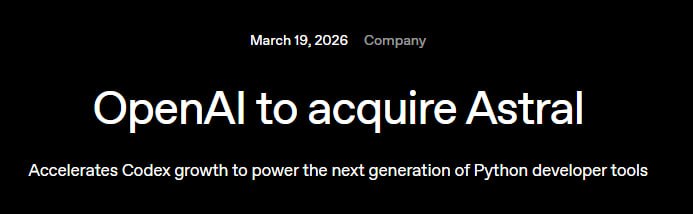
OpenAI has signed an agreement to acquire Astral, the company behind widely used open source Python tools uv, Ruff, and ty, and plans to integrate Astral’s tooling and team into its Codex product to build AI agents that can participate across the full software development lifecycle. Astral’s tools will remain open source, with both companies emphasizing that development will continue “in the open” while using Astral’s compiler, packaging, and static analysis expertise to deepen Codex’s integration with the Python ecosystem.
According to OpenAI’s announcement, the deal is intended to “accelerate Codex growth” by bringing developer-native infrastructure directly into the Codex stack, enabling more capable AI coding agents that can work with real-world workflows such as dependency management, linting, formatting, and type checking. Astral’s projects already underpin millions of Python workflows—uv as a fast Python package and project manager, Ruff as a popular linter/formatter, and ty as a high‑performance type checker—making them strategically valuable as building blocks for AI-assisted development tools. The acquisition is subject to customary regulatory approvals, after which the Astral team will formally join OpenAI’s Codex group and explore tighter integrations between Codex and Astral’s tools.
The move highlights a growing convergence between AI coding assistants and the core open source tooling they rely on, raising ecosystem questions about stewardship, governance, and long‑term independence of critical Python infrastructure. Both OpenAI and Astral explicitly commit to keeping the projects open source and continuing to serve the broader Python community, framing the deal as a way to scale impact rather than to close off the tools. For developers, the acquisition signals that future versions of Codex-powered products may interact more natively with common Python workflows, potentially turning Codex into a “true collaborator” that spans editing, testing, packaging, and deployment.
✨ AI-generated background, compiled from web sources — not editorial content.