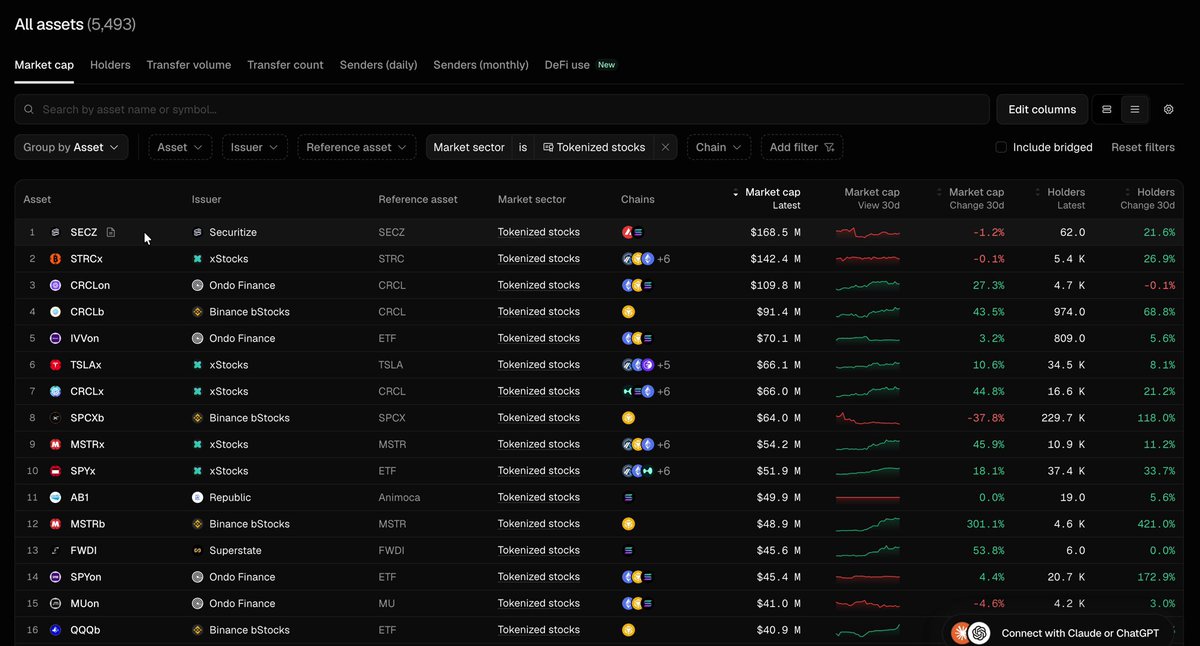
Securitize has announced plans to launch what it describes as the first fully compliant, fully onchain trading platform for real public-company stocks in early 2026, targeting Q1 for rollout. Unlike synthetic stock tokens that mirror prices via derivatives or offshore entities, the platform will list natively tokenized shares that are legally recognized as the actual equity of public companies, issued directly by the issuer and recorded onchain.
Under this model, each tokenized share is issued onchain, recorded directly on the company’s official cap table, and treated as the legally valid share, with the blockchain serving as the authoritative record of ownership. Securitize, acting as an SEC-registered transfer agent and broker-dealer, underpins the system so that token holders receive full shareholder rights, including dividends and proxy voting, while holding their shares in self-custody wallets. Transfers are permissioned and can only occur between compliant, whitelisted wallets, and trading will take place via a Web3 “swap-style” interface using stablecoins, with instant atomic settlement.
The move extends Securitize’s earlier work with Exodus Movement, Inc. (EXOD), which in late 2024 became one of the first public companies to issue its equity natively onchain through Securitize, demonstrating that fully regulated public-company stock can exist and be maintained on a blockchain without sacrificing investor protection. Securitize’s 2026 launch aims to move these tokenized equities from merely being issued and held onchain to being traded fully onchain in real time, including 24/7 markets supported by an automated market maker outside regular U.S. trading hours, while matching National Best Bid and Offer (NBBO) during market hours. If adopted at scale, this structure could significantly advance the tokenization of public equities by providing a compliant template for how onchain capital markets might integrate with existing securities regulation.
✨ AI-generated background, compiled from web sources — not editorial content.