Terms presented to Prisma: "Your team need to do an online press conference, in which all of your team must show their faces with ids (its like KYC), and send apologies and thanks to all of your users, your investors, and me."
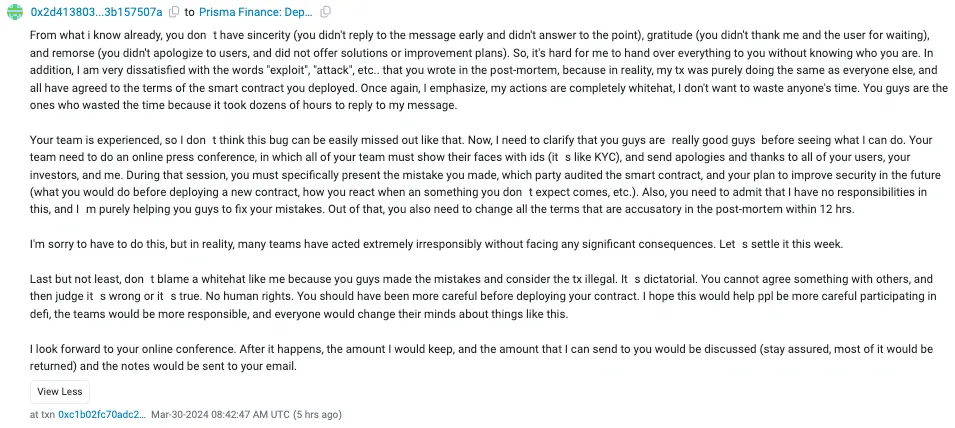
Terms presented to Prisma: "Your team need to do an online press conference, in which all of your team must show their faces with ids (its like KYC), and send apologies and thanks to all of your users, your investors, and me."
etherscan.io •
Revision history

7 recorded changes

Want your article here?

Promote with Leviathan News


An attacker who stole funds from Prisma Finance, a liquid staking protocol on Ethereum, has issued public, on‑chain demands that the core team dox themselves, apologize, and thank users, investors, and the attacker as a condition for returning remaining funds. The demand includes holding an online press conference where all team members must show their faces and IDs, effectively forcing a KYC‑style public reveal of the previously pseudonymous team. The ultimatum follows a major exploit of Prisma Finance in which the attacker drained user funds and later began communicating via on‑chain messages and public posts, criticizing the project’s security practices and claiming the team had "no remorse" and was "difficult" to negotiate with. In one of these messages, the attacker listed specific conditions for further discussions or any potential return of funds, including the press conference requirement, apologies to all affected parties, and personal acknowledgement of the attacker. These demands go well beyond normal "white hat" negotiations seen in some past DeFi exploits and are viewed as coercive and reputationally damaging, highlighting the extreme power imbalance that can arise when a protocol is compromised. This incident matters because it illustrates a growing pattern in DeFi where exploiters use on‑chain communication and public pressure not only to negotiate bounties or partial refunds but also to impose reputational or doxxing conditions on project teams. For protocols relying on pseudonymous developers, being forced into a public KYC‑style exposure can have legal, security, and personal safety implications, and it raises broader questions about norms around "ethical hacking" versus extortion in Web3 incident response.

AI-generated background, compiled from web sources — not editorial content.

More coverage

Explore the topic

Loading related coverage…

Comments

Loading comments…